
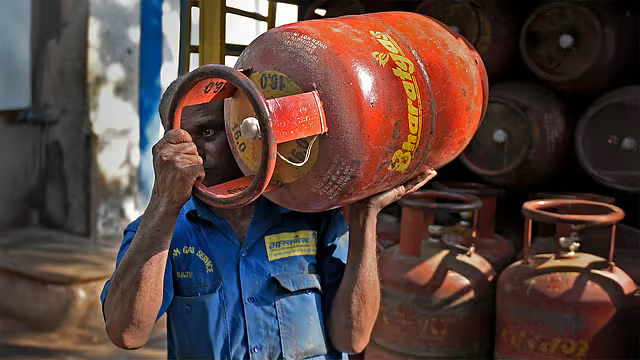
New Delhi: In a move that is set to impact the hospitality, catering and street food sectors, state-owned oil marketing companies (OMCs) on Sunday revised upward the price of commercial Liquefied Petroleum Gas (LPG) cylinders, effective June 1. The revision, however, leaves domestic household cylinder prices untouched.
In the national capital, the price of a 19-kilogram commercial cylinder has been raised by ₹42, bringing the new rate to ₹3,113.50. Kolkata has seen the steepest hike, with prices climbing by ₹53.50 to reach ₹3,255.50. The 5-kilogram free trade LPG (FTL) cylinder in Delhi now costs ₹821.50, following an ₹11 increase.
The OMCs — Indian Oil Corporation (IOC), Bharat Petroleum (BPCL), and Hindustan Petroleum (HPCL) — revise commercial LPG rates on the first of every month in line with international benchmarks and foreign exchange movements. Unlike household cylinders, which benefit from government subsidies and are subject to political sensitivity, commercial cylinders are unsubsidised and therefore more susceptible to market-linked pricing.
The revision has attracted criticism on two fronts. First, the significant cumulative hike — exceeding ₹1,400 since the beginning of this year — is seen by many as disproportionate, particularly given that global crude oil prices have been trending lower in recent months, partly on account of a de-escalation of tensions in the Middle East, which had been cited as a key driver of earlier price increases.
Second, the timing of the announcement drew pointed remarks on social media and from opposition voices. The revision was announced in the immediate aftermath of Royal Challengers Bengaluru's (RCB) triumphant IPL victory, prompting criticism that the government had used the celebration as a cover for an unpopular economic measure. While the monthly revision cycle makes the June 1 date routine, the optics drew sharp comment.
Industry observers and restaurateurs have flagged that successive hikes in commercial cylinder prices are compounding operating costs for the food service sector, already under pressure from elevated input costs. Small dhabas and street vendors, who rely heavily on commercial LPG for their daily operations, are expected to bear the brunt of the increase.
Questions have also been raised about India's import strategy. With the country sourcing a growing share of crude oil at discounted rates from Russia — a trend that has persisted since the onset of the Russia-Ukraine conflict — critics argue the benefits of cheaper procurement have not been passed on to end consumers or commercial users.
The government and OMCs have not issued a formal statement explaining the rationale for the June 1 hike beyond the standard market-linkage mechanism. Household LPG cylinders remain at ₹913 for a 14.2-kg cylinder in Delhi, unchanged for the period.